In almost every state, you need a state issued license in cosmetology or esthetics before you touch a client's lash line, and the license has to be tied to a facility that is itself registered or inspected. There is no federal lash credential. There is no national certification that substitutes for the license. A brand certificate from an adhesive manufacturer is training, not authority.
A handful of states have added a narrower specialty credential, sometimes called an eyelash extension specialist or lash technician license, that takes far fewer hours than a full esthetics program. Others fold lash work into esthetics and say nothing about it specifically, which means the general scope of practice governs you. A small number regulate the facility more aggressively than the individual.
The only reliable answer is the one you read yourself, in your own state's administrative code, on your own board's website. This piece is about how to find that answer, how to interpret the categories once you have it, and what an inspector standing in your studio will actually open and look at.
Why lash work sits under state cosmetology and esthetics boards
Lash extension application is regulated because it involves applying a chemical adhesive within a couple of millimeters of the eye, on a client who cannot see what you are doing and has both eyes closed for two hours. States classify that as a service to the body performed for compensation, which is exactly the definition that pulls a trade under a cosmetology board.
The practical consequence is that your obligations come from three separate places, and people conflate them constantly. Your personal license comes from the board. Your business registration and sales tax permit come from the secretary of state and the department of revenue. Your facility permit, if your state has one, is often a third filing. Being current on one says nothing about the other two.
Keep reading: How did one solo artist raise her rebook rate without adding a single new client?
Esthetician, cosmetologist and specialty lash license categories
Three categories cover most lash artists working legally in the United States today.
Esthetician. A skin care license, typically requiring somewhere between 600 and 1,200 clock hours of board approved schooling depending on the state, plus written and often practical exams. It is the most common route for a lash artist because the scope of practice covers the eye area and because it also permits brow shaping, tinting where allowed, and facial services if you later expand the menu.
Cosmetologist. The broadest license, usually 1,000 to 1,600 hours, covering hair, nails and skin. Overkill if you only intend to do lashes, but many artists already hold one from an earlier career in hair and simply add lash training on top.
Specialty lash or eyelash extension license. A narrow credential offered in some states, often in the range of a few dozen to a couple hundred hours, that permits extensions and little else. It is faster and cheaper to get. It also boxes you in: if your state's specialty scope does not name lash lifting or tinting, you cannot legally add those services later without going back for the fuller license.
Read the scope language before you choose the cheapest path. A specialty license that excludes lifts is a poor investment if lifts are where your market is heading.
How to read your board's rule instead of relying on hearsay
Rules differ by state and change on legislative cycles, so a confident answer from an artist two states over is worth nothing to you.
Here is a sequence that gets you to the primary source in about twenty minutes.
- Search for your state name plus "board of cosmetology" and confirm you have landed on a domain ending in .gov. If it ends in .com and is selling a course, leave.
- Find the link labeled laws and rules, statutes and rules, or administrative code. The statute is passed by the legislature. The rules are written by the board and carry the operational detail you need.
- Inside the rules, search the text for the words eyelash, extension, lash, and eyelash enhancement. Use your browser's find function on the full document rather than trusting the site's search box.
- Note the rule number, not just the sentence. When you later call the board or answer an inspector, citing the rule number ends the conversation.
- Check the effective date and any pending rulemaking notices.
- If the rules are genuinely silent on lash extensions, call the board's licensing line and ask what license category covers eyelash extension application. Write down the date, the name of the person, and what they said.
That last step matters more than it sounds. Boards answer this question by phone constantly, and a dated note in your file is what you produce if enforcement ever disagrees with what you were told.
Keep reading: Where is the lash and brow industry heading now that lash lifts are outselling extensions?
Facility and booth rental requirements separate from your license
You can hold a perfectly valid esthetics license and still be operating an unlicensed establishment. Many states require the physical location to hold its own salon, shop or establishment license, with its own application, its own fee and its own renewal date.
Home based studios attract the most confusion. Some states permit them outright. Some permit them only if the treatment space has a separate outside entrance, is physically separated from living quarters, and has its own sink. Some prohibit them entirely. Zoning is a fourth layer on top of all that, handled by your city or county, and a residential zoning restriction can shut you down even where the board is satisfied.
If you rent a booth or a room inside someone else's salon, ask whether your state treats you as an independent establishment. Where it does, the host salon's license does not cover you, and you file your own. Get a written lease that names who holds which license, who is responsible for sanitation in shared areas, and who the inspector should be handed to on arrival.
Sanitation, disinfection and single use item rules inspectors check
Inspections are usually unannounced. The inspector is generally not evaluating your lash work. They are checking a list, and the list is knowable in advance because it is published in the same rules document you already found.
| What they open | What they expect |
|---|---|
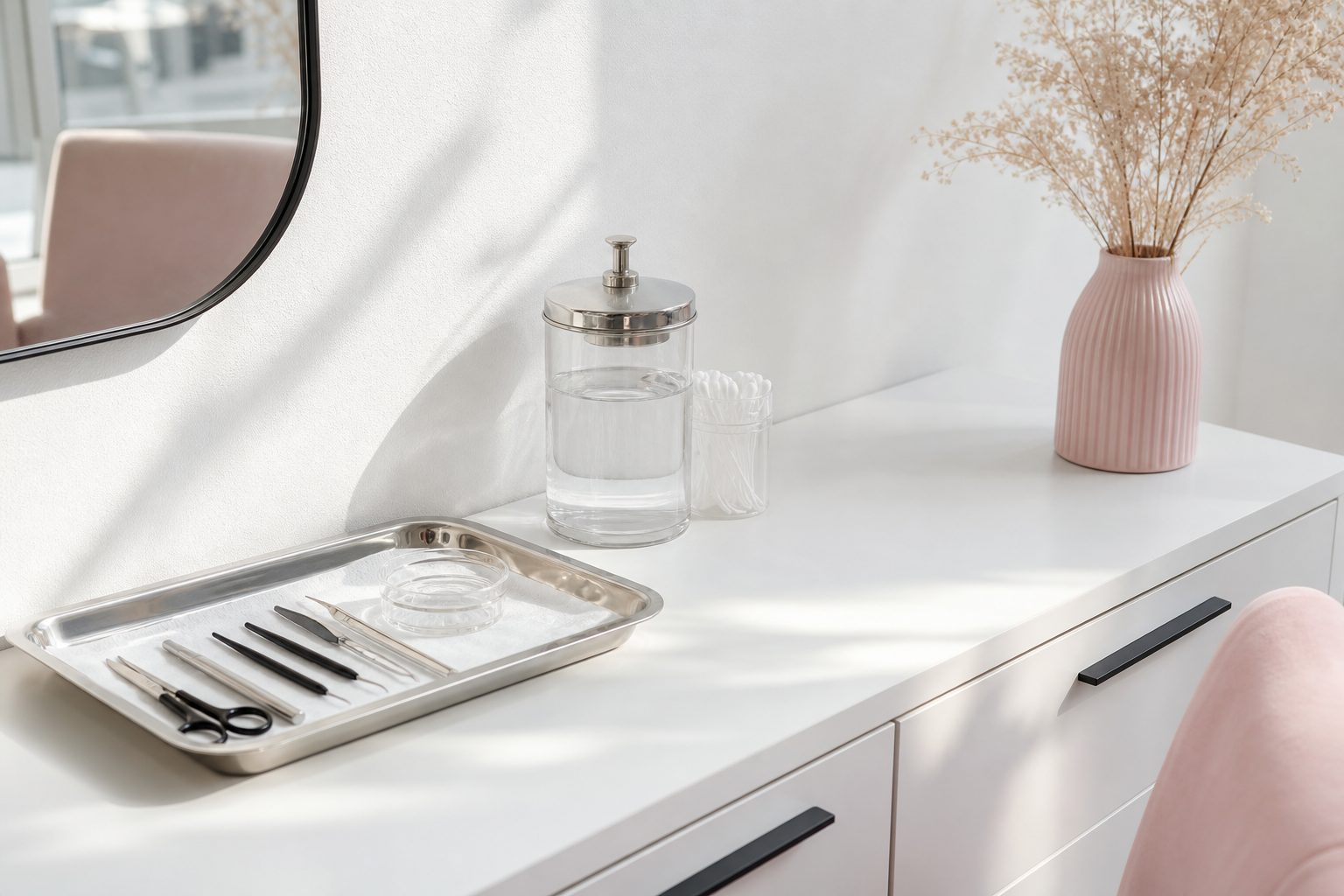
| Tool storage | Clean, disinfected tweezers stored separately from soiled ones, in a covered container |
| Disinfectant | An EPA registered, hospital grade product, mixed at label dilution, within its stated contact time, not expired |
| Single use items | Microswabs, mascara wands, gel pads and tape discarded after one client, never redipped |
| Linens | Clean covering changed between clients, soiled linens in a closed hamper |
| Handwashing | Accessible sink with soap and single use towels |
| License display | Your license and the establishment license posted where clients can see them |
| Waste | Covered trash, and where required a sharps or chemical waste arrangement |
Two details cause more violations than anything else. The first is a disinfectant jar with tweezers dropped in and no log or timer, which makes contact time unverifiable. The second is a bottle of anything decanted into an unlabeled container.
See how LashRetention handles this for lash and brow studios
Adhesive labeling, safety data sheets and product records
Lash adhesive is a cyanoacrylate. Under federal hazard communication requirements administered by OSHA, a workplace that uses hazardous chemicals must keep safety data sheets accessible to anyone working there, and containers must be labeled. That applies to a one bed studio with an employee just as it applies to a salon with twelve chairs, and state boards frequently write the same requirement into their own sanitation rules.
Practical version of compliance:
- Keep the manufacturer's safety data sheet for every adhesive, remover, primer, lift solution and tint you use, in a binder or a folder on a device you can open in front of an inspector.
- Never transfer adhesive or remover into an unlabeled dropper bottle. If you decant, label the secondary container with the product name and the hazard information.
- Keep adhesives in original packaging with the lot number legible, and note purchase dates. If a client reacts, the lot number is the first thing anyone will ask for.
- Ventilate. Cyanoacrylate vapor is an irritant, and adequate ventilation is both a rule in many states and the reason experienced artists stop getting headaches.
Keep a simple client record too: consultation notes, any disclosed allergy or eye condition, the adhesive used, and a signed consent form. Retention periods vary, so check your rule, but keeping records for several years is the defensible default.
Renewal cycles, continuing education and what follows a complaint
Most cosmetology and esthetics licenses renew on a one or two year cycle, with a fee and, in many states, a continuing education requirement measured in clock hours. Some states require specific subject matter within those hours, commonly sanitation, infection control, and state law. Courses have to come from board approved providers, and a manufacturer's brand class often will not count.
Renewal is a date, not a reminder. Boards do send notices, but they send them to the address of record, and an out of date address is not a defense. Put the renewal date and the establishment license date in whatever system already runs your studio calendar, ninety days ahead, so the deadline arrives with room to fix a problem.
If a client files a complaint, the usual path is written notice from the board, a request for your response and records, an investigation, and then either dismissal, a consent agreement with a fine and corrective education, or a formal hearing. Respond in writing by the stated deadline, produce the records you already keep, and consider counsel before you sign anything. Complaints handled promptly and documented well tend to end quietly. Ignored notices escalate.
Where compliance and retention meet
The paperwork side of this trade and the money side are not separate. Consent forms, adhesive records, aftercare instructions and consultation notes all live at the same moment: the client in your chair. Studios that capture them once, properly, spend less time chasing paper later and have a far clearer picture of who is actually coming back.
LashRetention keeps that record per client alongside the fill cycle, so the consultation note, the products used, the aftercare you sent and the next appointment sit in one place instead of three. Find your state's rule first, get your license and your facility permit right, then let the system carry the rest so your attention stays on the lash line.