With one bed, offer classic and one advanced style, not all three. The bed, not the menu, is your constraint: every service style you add costs practice hours, tray inventory and menu confusion, and the return on the third style is usually smaller than the return on filling the slots you already have.
Which two depends on your hands and your market. Classic plus hybrid is the lower risk pairing, because hybrid uses the same isolation skill with a smaller number of handmade fans and reads as an easy upgrade. Classic plus volume is the higher ceiling pairing, because volume commands the highest ticket and attracts clients who rebook tightly, but it takes the longest to get fast at.
What follows is the arithmetic behind that, so you can run it against your own rates rather than take mine.
Chair time per set and per fill for each service style
Time is the only thing you cannot buy more of on a single bed. These are working ranges for an artist who is competent but not exceptionally fast, and they include setup, cleanse, mapping and turnover.
| Style | Full set | Two week fill | Three week fill |
|---|---|---|---|
| Classic | 1h45 to 2h15 | 45 to 60 min | 60 to 75 min |
| Hybrid | 2h to 2h30 | 60 to 75 min | 75 to 90 min |
| Volume | 2h30 to 3h15 | 75 to 90 min | 90 to 120 min |
Two things fall out of that table immediately. First, a volume full set eats a third of your day. Second, the fill spread is narrower than the full set spread, which is why a mature book weighted toward fills is far more profitable than a book full of new sets, whatever the style.
Keep reading: What are the most common reasons my clients lose extensions in the first week?
Product cost per set: trays, adhesive, primer and remover
Product is a small share of the ticket, but it is not zero, and it scales differently by style. Work it from your own invoices. Here is the method with illustrative figures you should replace with your own.
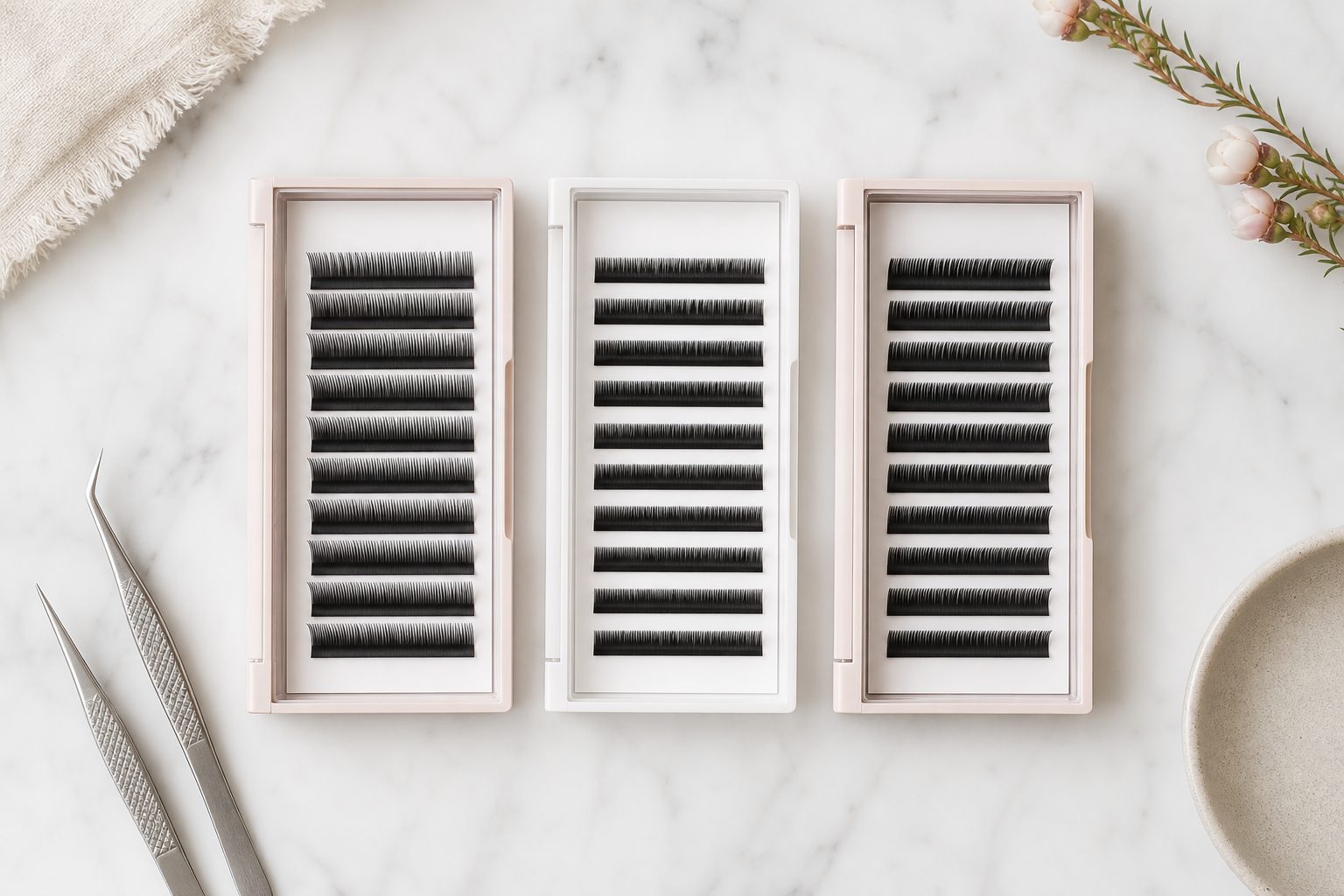
Assume a mixed length tray costs $12 and yields roughly 3,000 usable extensions across its lines. That is $0.004 per lash. A classic set using 160 extensions consumes about $0.64 of tray. A volume set building 3D fans on 160 natural lashes consumes 480 extensions, about $1.92.
Assume adhesive at $40 for 5ml, and that a bottle is discarded four to six weeks after opening regardless of what is left, because cured viscosity ruins retention long before the bottle empties. If you open one bottle a month and complete 20 sets and 45 fills in that month, adhesive costs about $0.62 per appointment. If you are quieter and complete 30 appointments total, the same bottle costs $1.33 per appointment. Slow months make your consumables more expensive per client, not less.
Add primer, cleanser, gel pads, tape, micro brushes, mascara wands and lint free applicators. In practice most artists land somewhere between $4 and $9 of consumables per full set, and $2 to $5 per fill. Volume sits at the top of both ranges because of tray consumption and longer application time on pads and adhesive.
Run your own version like this: total product spend for the last ninety days, divided by total appointments in those ninety days. That single number is more honest than any per item estimate, and it captures the waste you would otherwise forget.
Skill and practice time needed before pricing at full rate
Classic is a foundation skill: isolation, placement, direction, adhesive control. Most artists reach a saleable classic set faster than they reach a saleable anything else, because the failure modes are visible. A stuck lash is obvious.
Hybrid asks for the same isolation plus consistent handmade fans, usually 2D to 4D, mixed into classic lashes across a map. The new skill is fan symmetry and knowing where a fan belongs versus a single.
Volume asks for closed, even bases on every fan, at speed, with adhesive control tight enough that a fan does not become a clump. The base is what determines retention, and a wide base or one that reopens on the lash is the difference between a set that lasts three weeks and one that fails in six days.
Be honest about the interim period. If you charge a full volume rate before your fans are clean, you buy yourself unpaid redo appointments and a reputation you then have to correct. A model rate during practice is cheaper than the redos.
Keep reading: What does my state actually require before I can legally apply lash extensions?
Retention differences and what drives them per style
Style does not change biology. It changes load and bond surface.
- Classic puts one extension on one natural lash. Bond surface is the largest relative to weight, so retention is generally the most forgiving. The risk is diameter: a heavy single on a fine lash strains the follicle.
- Hybrid mixes both loads. Retention tends to sit between the other two, and problems usually trace to fans made too heavy for the lash they sit on rather than to the mixing itself.
- Volume spreads weight across finer diameters, which can be gentler on the natural lash than a heavy classic, provided the fan is genuinely light and the base is closed. When volume retention fails, the cause is nearly always base quality or too much adhesive, not the style.
The practical implication for a one bed studio: your volume retention is a direct readout of your fan technique. If your classic clients hold three weeks and your volume clients do not, the variable is your hands, not their lashes.
How each style affects fill interval and rebook rate
Interval is set by the client's shed cycle, but perceived interval is set by how visible the gaps are. A dense volume set hides early shed, because the fans around a lost lash close the space visually. A classic set shows every gap.
That cuts both ways. Classic clients often want to come in sooner because they can see the thinning, which is good for your rebook rate. Volume clients may look fine at week four and stretch, arriving with too little to fill and needing a partial rebuild.
Practical response: for volume clients, set the interval on evidence, not on how the set looks in the mirror, and say so at the bed. "It still looks full because the fans cover for each other. Underneath, you have lost about half. That is why I want you back on the twenty-second."
See how LashRetention handles this for lash and brow studios
Building a service menu that fits eight hours on one bed
Here is a worked day. Eight hours of bed time, one artist, thirty minutes total of turnover built into the appointment lengths above.
Option A, classic plus hybrid. One hybrid full set at 2h15, three classic fills at 1h each, one hybrid fill at 1h15. That is 6h30 of paid work in an eight hour block, five clients, with room for a mini fill or a late runner.
Option B, classic plus volume. One volume full set at 3h, one volume fill at 1h45, two classic fills at 1h each. That is 6h45, four clients, at a higher average ticket but with more exposure to a single cancellation.
Option C, fills only. Six fills across mixed styles at roughly 1h10 average. Seven hours of paid work, six clients, the highest revenue per hour of the three, and the day that only exists if your rebooking is working.
Compare those honestly. Option C is not a menu decision. It is a retention decision. The menu question is only interesting once your book is full enough that you have to choose what to put in the slots.
A decision rule for the one bed studio
- If you are under 60 percent booked, do not add a style. Add rebooking discipline. An empty afternoon does not care what is on your menu.
- If you are 60 to 85 percent booked and turning away nobody, add hybrid. It uses trays and adhesive you already stock and lifts your average ticket without a new skill curve.
- If you are above 85 percent booked and regularly declining new sets, add volume and raise classic pricing at the same time, so the slower service is not subsidized by the faster one.
- If your day is already fill dominated and you are declining work, stop adding styles and raise prices. Price is the only lever left on one bed.
When adding a second style costs more than it earns
Three situations where the third style loses money.
The first is inventory drag. Each style needs its own diameters and lengths, and lash trays do not improve with age. Trays bought for a service you sell twice a month are money sitting in a drawer.
The second is scheduling friction. A menu with nine service names and three fill windows makes online booking harder, produces more mis-booked appointments, and pushes you into the worst outcome on a single bed: a client arriving for the wrong length of appointment.
The third is skill dilution. Time spent getting adequate at a third style is time not spent getting fast at the two you already sell. On one bed, speed is revenue. Ten minutes cut from your standard fill, across five fills a day, five days a week, gives back more than four hours a week of bed time.
Deciding with numbers instead of instinct
Every judgment above turns on facts you should already be collecting: how long each service actually takes you, which clients rebook at the bed, and what percentage of the set is still attached when they arrive. Most studios guess at all three.
LashRetention keeps the fill cycle and retention score for each client, so you can see which style holds on which client, prompts the rebook at the right point in the cycle rather than weeks late, and sends aftercare automatically. Start by tracking two styles properly for a quarter. The menu decision will make itself, and it will be based on your bed and your book rather than on what everyone else is offering.