A full set of volume lashes typically costs a solo artist somewhere between $55 and $95 once you count consumables, chair time at your own hourly floor, a share of monthly overhead, card fees and an allowance for no shows. The wide range is not vagueness. It is the difference between a $600 a month suite and a $2,400 a month one, and between filling 22 hours a week and filling 12.
The number that matters is yours, not an average. Below is the arithmetic, built from the floor up, with every assumption stated so you can swap in your own figures. All the numbers in the worked example are illustrative assumptions, not measured industry data.
Do this once a year and after any rent change. It takes about thirty minutes and it is the difference between pricing from confidence and pricing from what the studio down the road charges.
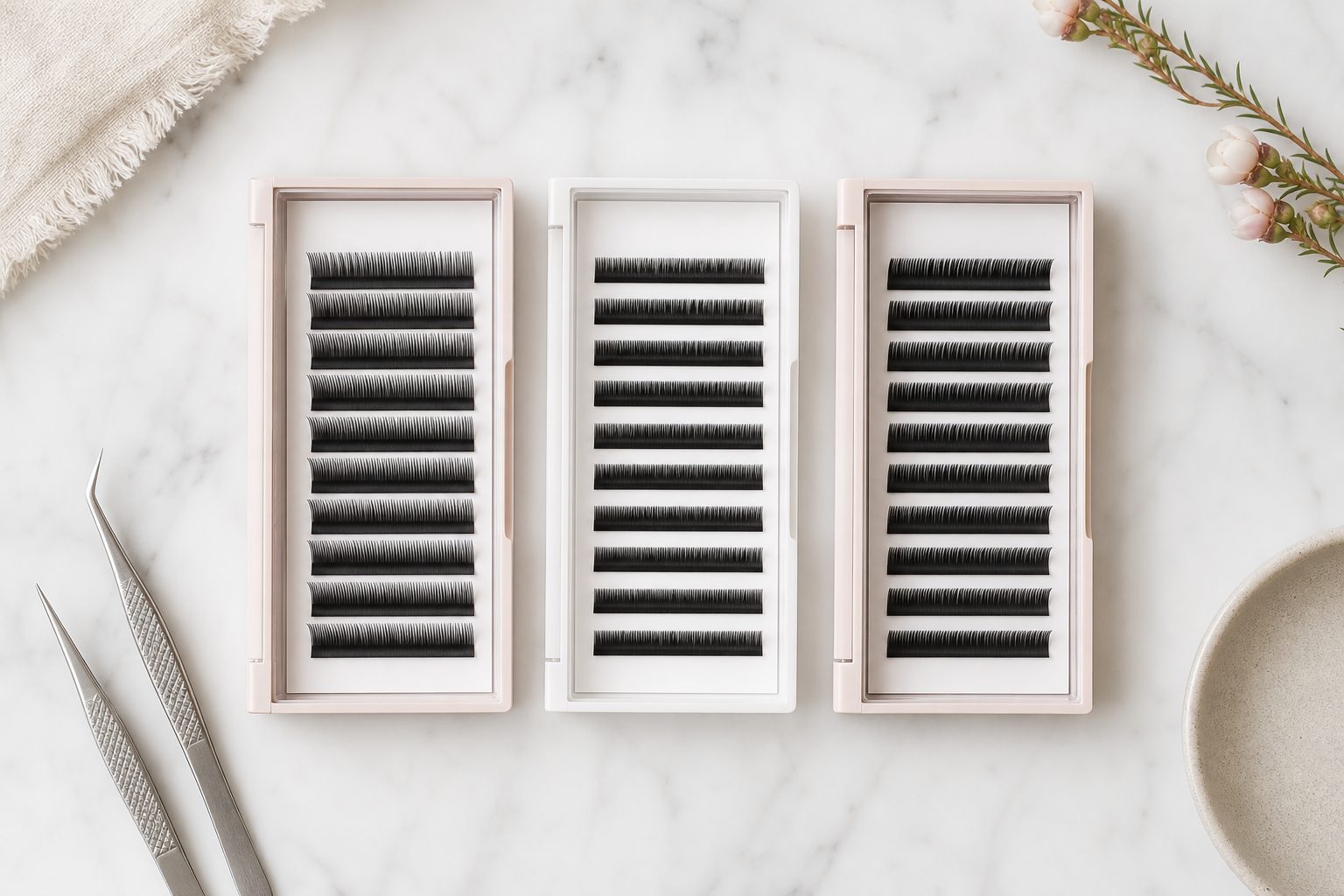
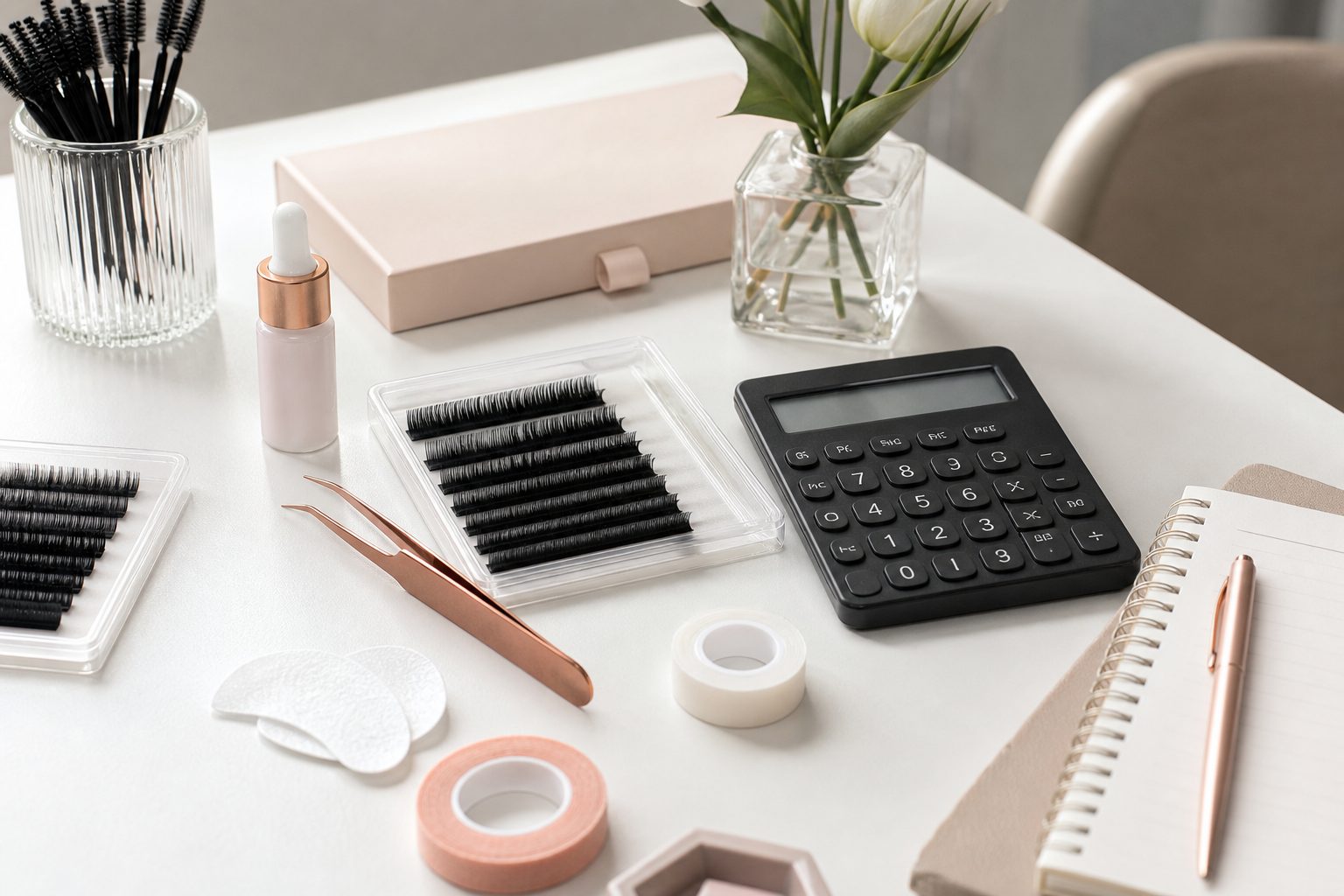
Consumables per set: trays, adhesive, primer, tape, applicators and gel pads
Start with what you physically consume and throw away. Assume these prices for the example:
| Item | Assumed cost | Sets per unit | Cost per set |
|---|---|---|---|
| Lash trays, promade or loose | $18 per tray | 6 | $3.00 |
| Primer and cleanser | $16 per bottle | 40 | $0.40 |
| Gel pads | $14 per 50 pairs | 50 | $0.28 |
| Medical tape | $9 per roll | 25 | $0.36 |
| Micro applicators and brushes | $12 per 100 | 25 | $0.48 |
| Aftercare card and spoolie | $0.75 | ||
| Linens, laundry, gloves, sanitizer | $1.20 |
That is $6.47 before adhesive. Adhesive deserves its own section because it is the one input where waste, not usage, drives the cost.
Keep reading: What actually happens to retention when a client works out five days a week?
Converting an adhesive bottle into a cost per appointment
You do not price adhesive by drops used. You price it by shelf life after opening, because that is what actually determines how much of the bottle you pay for and never use.
Assume a 5 ml bottle at $28. Manufacturers commonly advise using an opened bottle within about four to eight weeks, and you should follow whatever your specific brand states. Take four weeks as the conservative case.
If you do 5 full sets and 12 fills in those four weeks, that is 17 appointments sharing one $28 bottle: $1.65 per appointment. If a slow month gives you 8 appointments on that bottle, the same bottle costs $3.50 each. The busier you are, the cheaper your adhesive gets per client, which is a real and underappreciated economy of a full book.
Add $1.65 to the $6.47 and your consumable cost is roughly $8.12 per full set. Round to $8.50 to cover the dropped tray and the client who needs a second set of pads.
Chair time including setup, application and turnover
The mistake is counting only application time. A two hour volume set is not two hours of your day.
- Greeting, consult, intake and getting her taped up: 12 minutes
- Application: 120 minutes
- Mirror check, rebooking, aftercare, notes, photos: 10 minutes
- Station reset and disinfection: 12 minutes
That is 154 minutes, or 2.57 hours of occupied studio time. If you want to pay yourself $45 an hour for skilled labor, the labor component alone is $115.65. Notice what happened: a set you booked as two hours costs you 28 percent more in time than the booking suggests.
Keep reading: How do I know whether my three week fill cycle is realistic for a new client?
Fixed monthly overhead divided across realistic booked hours
Overhead does not care whether you are working. Assume:
- Suite or booth rent: $1,100
- Liability and product insurance: $45
- Booking software, website, phone: $75
- Continuing education set aside: $80
- Marketing, samples, retail displays: $90
- Laundry, cleaning, small equipment replacement: $60
Total: $1,450 a month. Now the honest part. Do not divide by 160 hours. Divide by hours you actually have a client in the chair. Assume 18 billable hours a week across 4.3 weeks: about 77 hours a month.
$1,450 divided by 77 equals $18.83 of overhead per occupied hour. Across 2.57 hours, that set carries $48.39 of overhead.
If your book drops to 12 billable hours a week, the same overhead becomes $28.10 an hour and $72 per set. Slow months are expensive months, which is precisely why keeping clients on a three week cycle rather than a seven week one changes your economics more than raising your price does.
Card processing fees and no show losses
Card processing commonly runs in the region of 2.6 to 3 percent plus a fixed per transaction fee, depending on your processor and whether the card is present. On a $180 set at 2.75 percent plus 15 cents, that is $5.10.
No shows and late cancels are a real cost line even with a policy, because policies get waived. Assume 5 percent of booked revenue is lost to gaps you cannot refill. On $180 that is a $9.00 allowance. If you take deposits and enforce them, use 2 percent instead.
See how LashRetention handles this for lash and brow studios
Building a floor price and a target price from those numbers
Stack the example:
| Line | Cost |
|---|---|
| Consumables including adhesive | $8.50 |
| Your labor at $45 an hour across 2.57 hours | $115.65 |
| Overhead share | $48.39 |
| Card fees | $5.10 |
| No show allowance | $9.00 |
| Total cost | $186.64 |
That is the eye opener. If you charge $180 for a volume set in this scenario, you are not making a small margin. You are paying yourself $45 an hour and nothing else, and slightly underpaying that.
Your floor price is the number where labor is paid and everything else is covered: about $187. Your target price adds profit that is not your wage, money for equipment, a slow January, and eventually a second bed. At a 20 percent margin over floor, that is $224, sensibly listed at $225.
If $225 is above what your market bears, the answer is not always to accept less. It is to cut the 154 minutes, raise your billable hours, or move to promade fans that shorten application without changing the result she sees.
Why a fill needs its own cost model, not a percentage of the full set
Pricing a fill at "half the full set" is where solo artists quietly lose money, because the cost lines do not scale together.
A two week fill might be 75 minutes of application, but setup, mirror check, notes and reset are unchanged at 34 minutes. Total occupied time: 109 minutes, or 1.82 hours. That is 71 percent of the full set's chair time, not 50 percent.
Consumables drop less than you think too. You use fewer lashes, but you use the same pads, tape, primer and adhesive share: call it $6.00 rather than $8.50.
Run the same stack at 1.82 hours: labor $81.90, overhead $34.27, consumables $6.00, plus fees and no show allowance on a $110 ticket of about $8.60. Total $130.77. A fill priced at half of a $225 set, so $112, loses money on every single visit.
There is a second effect. A client stretching to week five needs a longer, more expensive fill, and the interval between her visits is longer, so she generates less revenue per year from the same chair. Charge by the actual time band: a two week fill, a three week fill and a four week fill are three different services with three different prices.
Where to go from here
Fill in this table with your own rent, your own adhesive price and your own honest billable hours. Do it in a spreadsheet, once, and keep it. The exercise usually moves a price by $20 to $40 and it moves it with reasons you can say out loud to a client.
The largest variable in the whole model is not your product cost. It is how many hours the chair is occupied, which is a function of whether clients come back on cycle. LashRetention tracks each client's fill cycle, scores retention across visits and sends the rebooking prompt at the right day for her, which is the cheapest way there is to lower your overhead per hour.